


Your smallest traffic source might be your best-converting one.
That is the finding from new research into AI referral traffic, and it changes the case for LLM SEO from a future-proofing argument into a lead generation one. Visitors arriving from ChatGPT and similar tools make up a tiny fraction of total website traffic. But when they do arrive, they are considerably more likely to become an enquiry than visitors from organic search or direct.
There is now large-scale independent research behind it, and the same pattern appears in several of our own clients’ analytics.
AI referral volumes are still small, but they are growing, and that is exactly why now is the time to understand them. AI search is expanding quickly. The businesses that know how it sends traffic, and what that traffic does when it lands, will be the ones ready for it. The rest will be catching up.
What the research found
Andy Crestodina and the team at Orbit Media analysed GA4 data from 97 B2B lead generation websites, covering 28.9 million sessions between July 2025 and June 2026. Every site in the sample had at least 100 AI-referred sessions, so nothing was drawn from a handful of visits.
The headline finding: visitors from AI sources were roughly three times more likely to convert into a lead than visitors from other organic channels.
Measured as a per-site median, rather than pooling every session together, that gap widened to around seven times. And the pattern showed up on approximately two thirds of the individual sites, not just in the combined total. That consistency is what lifts it above anecdote.
A few other findings worth having to hand:
- AI accounted for about 0.5% of all traffic across the dataset. Roughly one visit in every two hundred.
- ChatGPT drove the large majority of AI referrals, well over 80% of them.
- The gap held for high-intent actions like contact forms and demo requests, and for lower-intent ones like newsletter signups and downloads.
The full study, with the methodology published alongside it, is on the Orbit Media blog, and Andy has also written it up on LinkedIn. It is careful work and worth reading in full if you are the one building the business case.
Why AI visitors convert better
The mechanics are reasonably intuitive once you picture the journey.
The shortlisting already happened. Someone using ChatGPT to find a supplier has had a conversation before they ever reach your site. They described their problem, asked for options, compared them, narrowed down. The consideration stage took place inside the model. By the time they click through, they are not browsing. They are checking.
They arrive late in the decision journey. Traditional organic search catches people across the whole funnel, including plenty who are just reading. AI referrals skew towards people who have already done the thinking. Fewer visitors, further along.
A recommendation does not read like an advert. When an AI names your business in response to a direct question, it lands as advice. Compare that to arriving via a results page stacked with paid placements, where the instinct is to stay sceptical and keep looking. The framing is completely different before the visitor has read a single word of your copy.
People do not open ChatGPT to browse. Nobody uses it to kill ten minutes the way they scroll social. They open it with something specific to solve. That intent is already in place before they land on your page. Our explainer on how AI search engines work covers what happens between the question and the click.
This is also, incidentally, why the low traffic volume is not the problem it first appears. AI is filtering out poor-fit prospects earlier in the process. Fewer visits, better ones.
What we are seeing in our own client data
We looked at our own clients’ GA4 accounts to see whether the pattern showed up. In several cases it did, clearly.
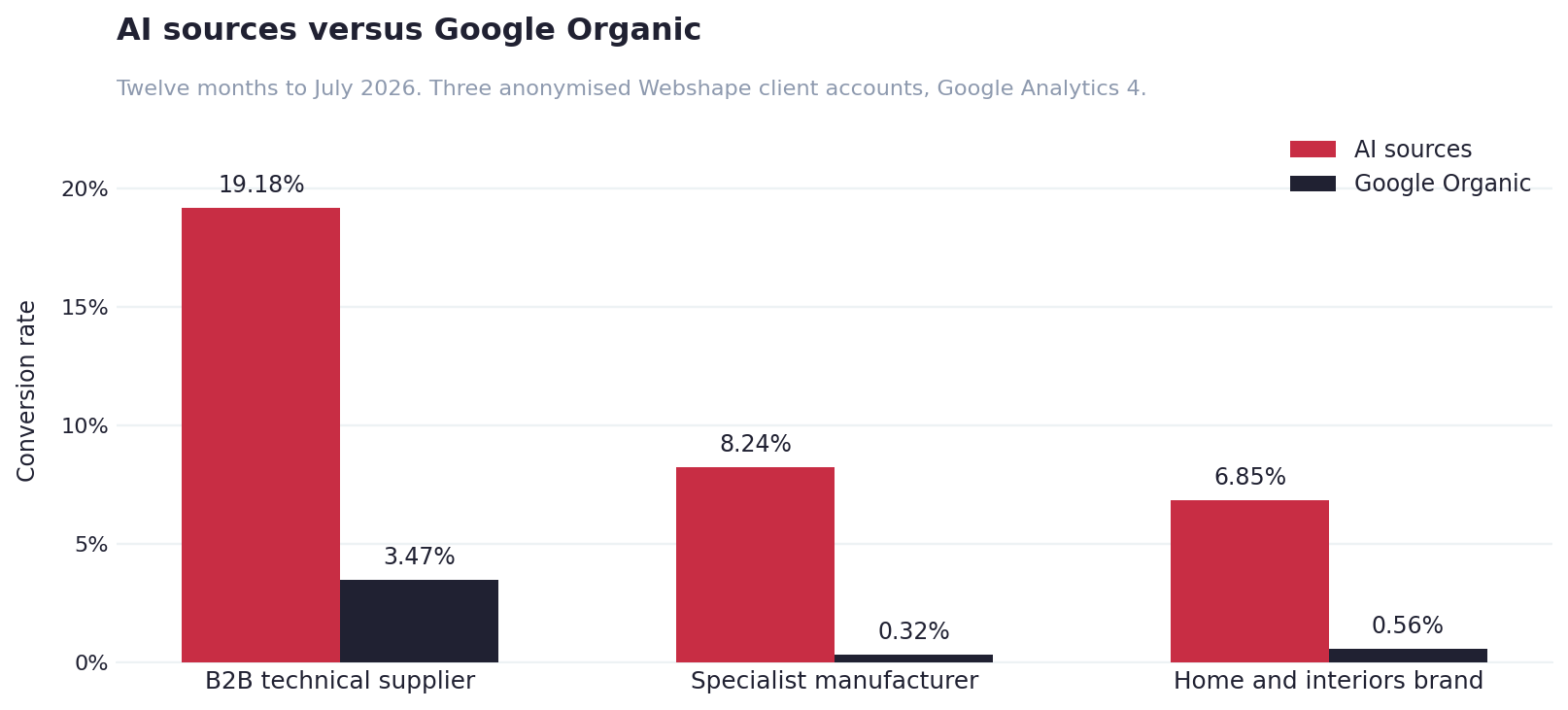
A B2B technical supplier we work with saw AI-referred traffic convert at just over 19%, against roughly 3.5% from Google Organic and around 6% from Direct over the twelve months to July 2026. That is a substantial gap on a site where enquiries genuinely matter to the business.
A specialist manufacturer showed a similar shape. Sessions tagged specifically as coming from ChatGPT converted at just over 8%, while Organic sat below half a percent and Direct lower still. The AI sample was 85 sessions, so we would not build a strategy on that figure alone, but the direction is consistent with the research.
A consumer-facing brand in the home and interiors market showed it too. ChatGPT-referred sessions converted at just under 7%, against roughly 0.6% from both Google Organic and Direct. Every ChatGPT row on that account sat above the site baseline, rather than one lucky conversion carrying the average.
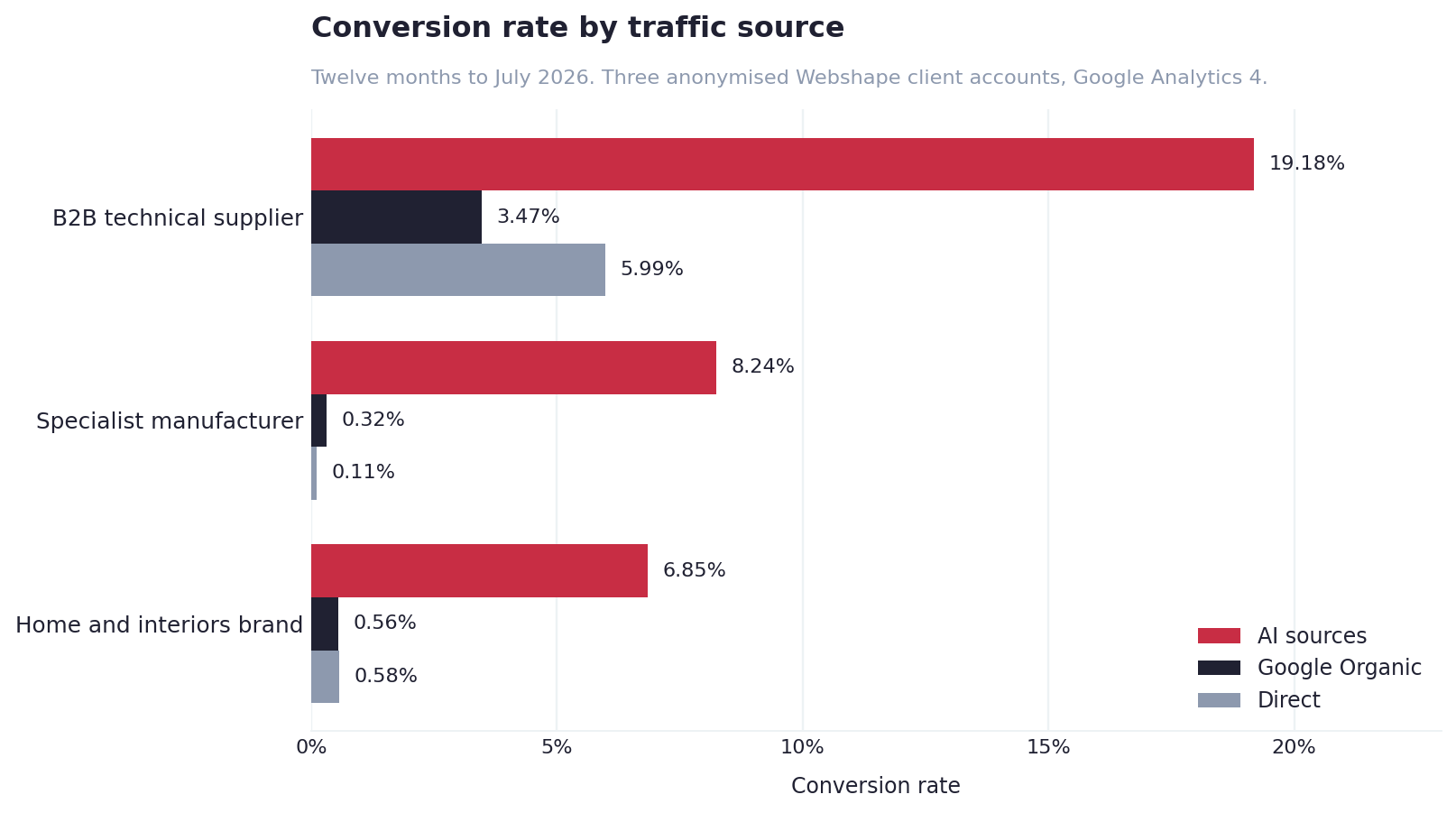
Three separate accounts, in three different markets, moving in the same direction as research built on 97 sites and 28.9 million sessions. When your own data and independent research at that scale agree, the pattern is worth taking seriously. The useful next step is to check your own numbers.
Why most businesses have no idea this is happening
Here is the part that makes this genuinely difficult to spot in your own reporting.
Google’s AI Overviews and AI Mode record in GA4 as Organic Search. There is no way to separate those clicks from clicks on traditional blue links. If a buyer reads an AI summary, clicks through and enquires, that conversion is credited to organic search.
Traffic from AI mobile apps often records as Direct, because the app strips the referrer and GA4 has nothing to work with. Same story if someone reads a recommendation and then types your URL in manually.
The practical consequence: the 0.5% figure is almost certainly an underestimate, and your own dashboard is understating AI’s contribution too. Most businesses are not choosing to ignore this. They simply cannot see it in the reports they already have. Our guide on which website analytics are worth tracking covers where the gaps in standard reporting tend to sit.
What this means for your budget and LLM SEO
If you are the one justifying content and SEO spend internally, the argument shifts slightly.
The old framing was about volume. Rank higher, get more traffic, convert a percentage of it. That still holds, and organic search is still driving vastly more traffic than AI. Google sends something like a hundred times more visits. Nobody should be moving budget away from search on the strength of this.
The new framing is about quality per visit. A channel delivering 0.5% of traffic at three to seven times the conversion rate is doing real work relative to its size. It is the same principle we wrote about in why more traffic doesn’t always mean more enquiries, just arriving from a new direction.
What actually influences whether an AI recommends you is not mysterious. It comes down to whether your site clearly answers the questions buyers ask, whether it names the outcomes you deliver, and whether there is evidence on the page that a model can quote. This is what people mean by GEO SEO or LLM SEO, and in practice it overlaps heavily with the on-page work that makes a site convert human visitors too. Our post on optimising your website for ChatGPT and AI language models goes into the specifics.
If you need to take this to your leadership team, that is the practical version: credible third-party evidence for content and on-page investment, from a named source with published methodology.
And if you are the one approving the spend, the point is that the budget already allocated to search visibility is doing double duty. The same pages that rank are the pages AI reads and quotes. This is not a request to fund a second channel.
Is your site set up to be found and trusted by AI?
Being quotable is not a separate discipline bolted on to your website. It is a consequence of having clear, well-structured, evidence-backed pages, which is the same thing that makes a site work for people.
If you want to know where you currently stand, our post on how to check whether your business is visible to AI search engines walks through it, or you can run a free website health check to see how your foundations look.
And if you would rather talk it through, get in touch. We will tell you honestly whether this is worth your attention right now or whether there is something more pressing to fix first.
Frequently Asked Questions
Does AI referral traffic actually generate enough volume to matter?
On its own, not yet. AI accounted for around 0.5% of traffic in the Orbit Media study, and organic search is still driving roughly a hundred times more visits. The reason it matters is conversion rate rather than volume, and the fact that real AI influence is higher than the reported figure because AI Overviews record as organic search and AI apps often record as direct.
How do I see AI traffic in our own GA4?
Look at Traffic Acquisition and segment by session source or medium, checking for referrers like chatgpt.com, perplexity.ai and gemini.google.com. GA4 also began applying an “AI Assistant” medium in mid-May 2026, so data before that point will be tagged differently. Compare conversion rate by source rather than looking at session numbers alone.
Is this pattern reliable enough to change our marketing plan?
It is reliable enough to inform your plan, not to rebuild it around. The Orbit Media research found the advantage held on roughly two thirds of the 97 sites studied, and it appeared clearly in the client accounts we reviewed. Treat it as a reason to make your pages clearer and more quotable, which is worth doing regardless, rather than as grounds for moving budget out of search.
What is the difference between LLM SEO, GEO SEO and traditional SEO?
Traditional SEO aims to rank a page in a list of results. LLM SEO and GEO SEO aim to get your business named and quoted inside an AI-generated answer. In practice the work overlaps heavily: clear structure, direct answers to real buyer questions, and evidence on the page. There is no separate technical trick, which is why it tends to improve conversion for human visitors too.
Should we be spending separately on AI visibility?
Usually not as a separate line item. The pages that rank well in search are largely the same pages AI reads and cites, so the content and on-page investment you are already making covers most of it. Where it is worth deliberate attention is in how clearly your service pages state outcomes, name your buyer, and provide quotable evidence.
Why would AI traffic convert worse on some sites?
Because conversion depends on more than visitor intent. If AI is sending people to a page that does not match what they were promised, or the site makes it hard to enquire, high intent will not survive contact with the page. Sector matters too. In the Orbit Media research the advantage did not appear on around a third of sites, which is why it is worth checking your own data rather than assuming.